
The right Tidio alternative depends on what your current bill is metering. Some tools charge per conversation, some per agent seat, some by AI resolutions, and a few charge once. If chat volume is low and you run one shop, a free hosted tier is usually enough. If you run several shops, or your conversation cap hits hardest in your best sales months, the billing model matters more than any feature list.
TL;DR:
- Before you compare features, compare billing models: per conversation, per seat, per AI resolution, or one-time. That choice drives most of your three-year cost.
- Conversation caps hit hardest in your best months, such as Q4, launches, and viral posts. Size any plan against your peak month, not your average.
- Running several shops on separate hosted accounts multiplies the bill. One shared inbox with per-shop branding fixes the cost and the tab-switching.
- If you run one small shop with fewer than a few chats a day, a free hosted tier beats self-hosting. Don't take on a server you don't need.
- Self-hosting removes monthly fees but makes you responsible for TLS, updates, backups, and your GDPR role as data controller.
Table of Contents
- Why Tidio Bills Climb: Conversations, Seats and the AI Meter
- The Main Types of Tidio Alternative, and the Problem Each Solves
- Three-Year Cost: One Shop vs. Four Shops
- When a Free Tidio Alternative Is the Right Call
- Self-Hosting Trade-Offs No Pricing Page Mentions
- Chatbots, AI Agents and the "Top Conversational AI Companies" Question
- How to Switch Without Losing Chat History or Sales
- Get One Inbox for Every Shop for a Single $299 Payment
- Frequently Asked Questions
- Sources
Why Tidio Bills Climb: Conversations, Seats and the AI Meter
Tidio is a customer-messaging app aimed mostly at small online stores. It puts a live chat widget on your site and adds rule-based chatbots that answer common questions or collect emails. It also offers an AI agent that tries to resolve questions without a human, plus a basic ticketing inbox. Its pitch is quick setup and ecommerce integrations, which is why so many first-time store owners start there.
The cost structure is what pushes people to search for an alternative. Tidio's pricing page meters plans by billable conversations, and AI-handled conversations come with their own allowance or add-on. That means three separate dials can move your bill:
- Conversation volume. Each plan includes a set number of conversations. Go past it and you either upgrade or stop answering.
- The AI allowance. Automated answers are counted separately, so a bot that works well uses up its quota faster.
- Team size and stores. Adding people or running a second shop often means a higher tier or a second account.
None of this is hidden. The trouble is timing. A conversation cap does nothing in a quiet February and squeezes you in November, which is exactly when the extra chats are worth the most.
A conversation cap is the only pricing model that charges you more in the month your marketing works.
The Main Types of Tidio Alternative, and the Problem Each Solves
Most "best alternatives" lists rank a dozen tools on one scale. That isn't very useful, because the tools aren't solving the same problem. It works better to sort them by what they bill and what they are built around. Then pick the category before you pick the product.
| Category | Typically bills by | Built for | Pick it when |
|---|---|---|---|
| Hosted chat widget with free tier | Conversations, then tiers | Single small shops | Volume is low and you want zero setup |
| Ecommerce help desk | Tickets or seats | Support teams handling email, chat and social | Chat is a minor channel in a ticket-heavy operation |
| Enterprise messaging suite | Seats, plus AI resolutions | Funded companies with product-led onboarding | You need in-app messaging and product tours, not just store chat |
| Social DM automation builder | Contacts or subscribers | Instagram, Messenger and WhatsApp funnels | Your sales start in DMs, not on your website |
| Shared email inbox | Seats | Teams collaborating on email threads | Email is the main channel and chat is an afterthought |
| Self-hosted chat, one-time license | One payment, plus your server | Owners who want fixed costs and their own data | You run several shops or hate seat math |
| Open-source chat or help desk | Free, plus your time | Technical teams | You have a developer and want to customize everything |
A few pairings people search for come down to this table:
- Tidio vs. a large enterprise messaging suite. You trade a cheap entry price for heavier tooling and per-seat pricing that scales steeply. We break down that seat math in our look at what actually saves owners money when leaving the big messaging platforms.
- Tidio vs. an ecommerce help desk. Help desks win when most of your volume is email and returns. They are overkill if you mostly need someone to answer "does this run small?" in real time.
- Tidio vs. a DM automation builder. These tools are built for social funnels and are priced by contacts. They don't replace website chat, so many shops end up running both.
Three-Year Cost: One Shop vs. Four Shops

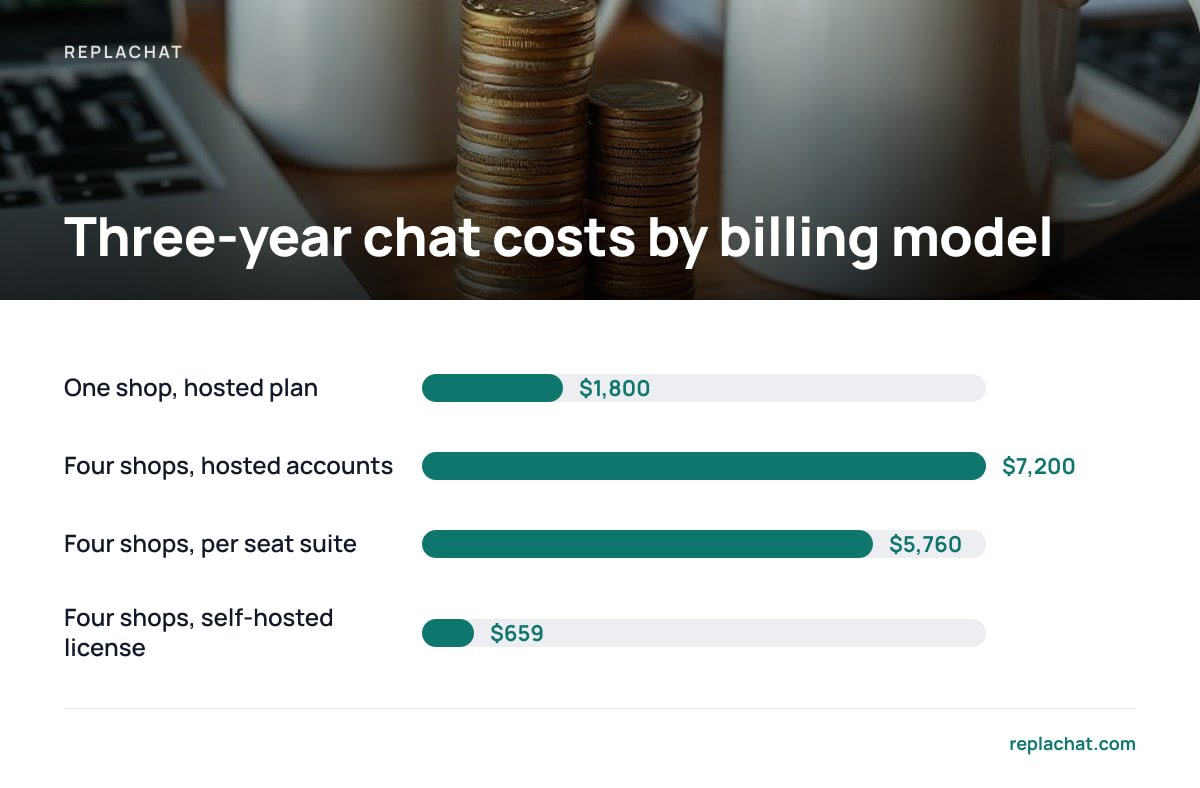
Pricing pages show a monthly figure. Your accountant sees a three-year one. The figures below are illustrative, using round numbers to show how billing models compound. Check them against the current price of whatever you're comparing.
| Scenario | Monthly model | Year 1 | Three-year total |
|---|---|---|---|
| One shop, one hosted plan at $50/month | Subscription | $600 | $1,800 |
| Four shops, four hosted accounts at $50/month each | Subscription ×4 | $2,400 | $7,200 |
| Four shops, one seat-priced suite, 4 agents at $40/seat | Per seat | $1,920 | $5,760 |
| Four shops, self-hosted one-time license ($299) plus a $10/month server | One-time plus hosting | $419 | $659 |
The multi-shop row is the one most comparison articles skip. If you run several stores, you probably either pay for an account per store or squeeze every brand into one widget that shows the wrong logo. We go deeper into that problem in what live chat for multiple stores really costs.
Four shops on four $50-a-month accounts is $7,200 over three years, before you add a single extra seat.
The obvious conclusion, "self-hosted is always cheaper," is wrong for some readers. That brings us to the next section.
When a Free Tidio Alternative Is the Right Call
If you run one shop and get a handful of chats a week, stay on a free hosted tier. Free tiers from hosted chat vendors are capped, but a cap you never reach costs nothing. Setting up a server to save $0 a month is a poor use of a weekend.
A free hosted tier is usually enough when all of these are true:
- One storefront. No second brand, so you don't need per-shop branding.
- One or two people answering. Seat limits on free plans rarely matter at that size.
- Peak month under the cap. Check your busiest month from last year, not your average.
- No strict data-residency requirement. You're comfortable with chat transcripts living on a vendor's servers.
Is there a free alternative to the big help-desk suites? Yes, in two forms. Many help-desk vendors offer free plans limited by agents, channels, or features, which suit a solo founder answering email. Open-source help desks are free to download, but you pay in hosting, maintenance, and the time it takes to configure ticket routing. "Free" in either case means you pay with limits or with labor, so pick the kind you would rather pay.
Once a second shop, a third agent, or a real Q4 spike shows up, the math reverses quickly. That's the point where a fixed-cost tool usually starts paying for itself.
Self-Hosting Trade-Offs No Pricing Page Mentions

A one-time license removes the monthly bill. It does not remove responsibility. If you run chat on your own server, you take on these jobs:
- Transport security. Chat must run over HTTPS, and the live connection uses WebSockets, which your host must allow. Free certificates from Let's Encrypt handle the TLS side and renew automatically if set up properly.
- Patching. Web apps fail in predictable ways. The OWASP Top 10 is the standard list, covering injection, broken access control, and outdated components. Unpatched software is a risk you now own.
- Backups. Transcripts often contain order numbers, addresses, and complaints. Schedule database backups and test a restore at least once.
- Your data protection role. Under the GDPR, hosted chat vendors act as processors and need a contract with you covering the points in Article 28. Self-hosting removes the chat vendor from that chain, though your hosting provider may still be one. Either way, you still owe customers a privacy notice and sensible retention limits.
The payoff is control. Your transcripts stay in your database, you aren't bound by a vendor's retention policy, and you face no price change at renewal because there's no renewal.
Chatbots, AI Agents and the "Top Conversational AI Companies" Question
What are the top 10 conversational AI companies? Any fixed top-10 list goes stale within a quarter. These lists also mix companies that do very different things. They tend to lump together foundation-model labs that build the underlying language models, contact-center platforms sold to large enterprises, customer-service suites with AI resolution add-ons, and small-business chat widgets with built-in bots. For an online shop, a better question is which layer you're buying and how it's billed. AI resolutions are often priced per answer, so a busy month makes the bill unpredictable again.
Most shops should get human live chat right first and automate second. A bot trained on a messy FAQ gives confident wrong answers about shipping times, which is worse than a 3-minute wait for a person. We cover the order of operations in chatbot vs. live chat: which one your shop needs first.
The stakes are real. The Baymard Institute's running average of documented cart abandonment studies sits at roughly 70%. A shopper with an unanswered question about sizing or delivery is often one of them. A fast human answer at checkout is the simplest fix.
Is there anything better than the popular AI companion apps? If you arrived here looking for an AI friend or companion chatbot rather than a business tool, this is a different category. Companion apps are built for ongoing personal conversation. Store chat tools are built to answer customers and close sales. "Better" in that category mostly comes down to privacy terms and how the app handles your data. Read those before you share anything personal.
How to Switch Without Losing Chat History or Sales
Switching chat tools takes an afternoon if you plan it and a lost weekend if you don't. Work through it in this order:
- Export transcripts first. Many hosted tools only keep history while you're subscribed. Download it before you cancel, not after.
- List every place the widget code lives. Theme files, tag managers, landing-page builders, and checkout customizations. Old widgets left on one page will confuse customers.
- Recreate canned responses. Your saved replies hold years of tuned wording for shipping, returns, and sizing. Copy them out of the old tool before you lose access.
- Set permissions per shop before launch. Decide who answers which brand. One agent replying as the wrong store is the most common multi-shop mistake.
- Run both widgets on a low-traffic page for a day. Confirm notifications reach phones and that offline messages land somewhere a person will see them.
Pro Tip: Before you choose any plan, pull your conversation counts for the last 12 months and find the single busiest week, not the busiest month. Black Friday and launch weeks can pack a month's volume into five days. Any tool with a cap or per-resolution pricing should be sized against that week. If you can't get weekly numbers out of your current tool, treat that as a reason to own your data next time.
Adding people after you switch is where seat-based tools quietly get expensive again. That's worth reading about in live chat for multiple agents without paying for every seat.
Get One Inbox for Every Shop for a Single $299 Payment

ReplaChat was built for the multi-shop owner in the cost table above. You pay $299 once and run it on your own server. You get one shared inbox for every store, a separately branded chat bubble on each site, and owner, admin, and agent roles you can set per shop. That way your returns person sees only the shops they handle. There are no per-agent fees, no monthly bill, and no conversation cap, so a record Q4 costs the same as a slow March.
The license includes the complete source code, 12 months of updates, and 30 days of setup support. The caveat is that you're the host: TLS, backups, and server costs are yours, as described in the self-hosting section. If you run one small shop that never hits a free tier's cap, you don't need it. Try the live demo, which has five shops and four people set up, then check our spec sheet against your own peak week before you buy ReplaChat.
Frequently Asked Questions
What is the Tidio app used for?
Tidio adds a live chat widget, rule-based chatbots, an AI agent, and a basic ticketing inbox to a website. It's mostly used by small online stores to answer shopper questions and collect leads. Plans are metered by conversations, with AI-handled conversations counted separately.
Is there a free Tidio alternative?
Yes. Several hosted chat vendors offer free tiers, and open-source chat tools are free to download. Free hosted tiers are capped by conversations, agents, or features. Open-source tools cost you hosting and maintenance time instead.
Is self-hosted live chat cheaper than a subscription?
For several shops or several agents, usually yes. A one-time license plus a small server can cost a few hundred dollars over three years, compared with thousands for per-account or per-seat plans. For one low-volume shop, a free hosted tier is cheaper still.
Do I need a chatbot or live chat first?
Most online shops should get fast human live chat working first. A bot trained on incomplete answers can give confident wrong replies about shipping or returns. Add automation once you know which questions repeat.
What happens to my chat history when I switch tools?
Many hosted tools only keep transcripts while your subscription is active. Export your history and canned responses before you cancel. A self-hosted tool keeps transcripts in your own database, so there's no export deadline.
Sources
- Tidio Pricing | Tidio
- Cart Abandonment Rate Statistics | Baymard Institute
- Art. 28 GDPR – Processor | gdpr-info.eu
- OWASP Top Ten | OWASP Foundation
- Let's Encrypt | Internet Security Research Group